The Row Bags In Detail: A Definitive Breakdown to the Collection
Look at the average designer handbag and it gives away who made it long before you have taken in the silhouette. The Row does the opposite entirely, and almost everything about how its bags are designed, priced and resold comes back to that one choice. Mary-Kate and Ashley Olsen launched the brand in 2006 and named it after Savile Row in London, the street that gave tailoring its vocabulary of restraint. New York City is home to the company: a design studio has been in Tribeca since 2012, a Paris office opened in 2011 and a London office arrived in 2019. Its own boutiques are located in Los Angeles, New York, London, Paris and Amagansett, and everything else goes through the brand’s own webstore and a short list of stockists. Take this as a row bags overview, running through the families that matter, the specifications that separate them and what each one costs. Each number that follows is a market price observed in 2026, not an official price list, since the brand issues none.
Identifying a The Row Bag With No Logo
With no exterior logo plaque and no monogram on any style, identification depends on silhouette, proportion and construction. Low on the side of the bag sits a small, discreet exterior stamp designed to blend into the leather rather than stand out against it, with a second stamp placed within the interior. Palladium-plated hardware comes matte or brushed, absorbing light rather than scattering it around the room. Linings matter as materials in their own right, so nappa, lambskin, calfskin and cotton herringbone line the interiors that a logo jacquard would do elsewhere. What governs the tailoring, namely that a garment is judged by its line rather than its label, applies to the bags without dilution. The brand’s own product pages list Made in Italy for the Half Moon, row-fashion.com Soft Margaux 10 and 12, Margaux Shoulder 12, Bourse Clutch and Terrasse To-Go.
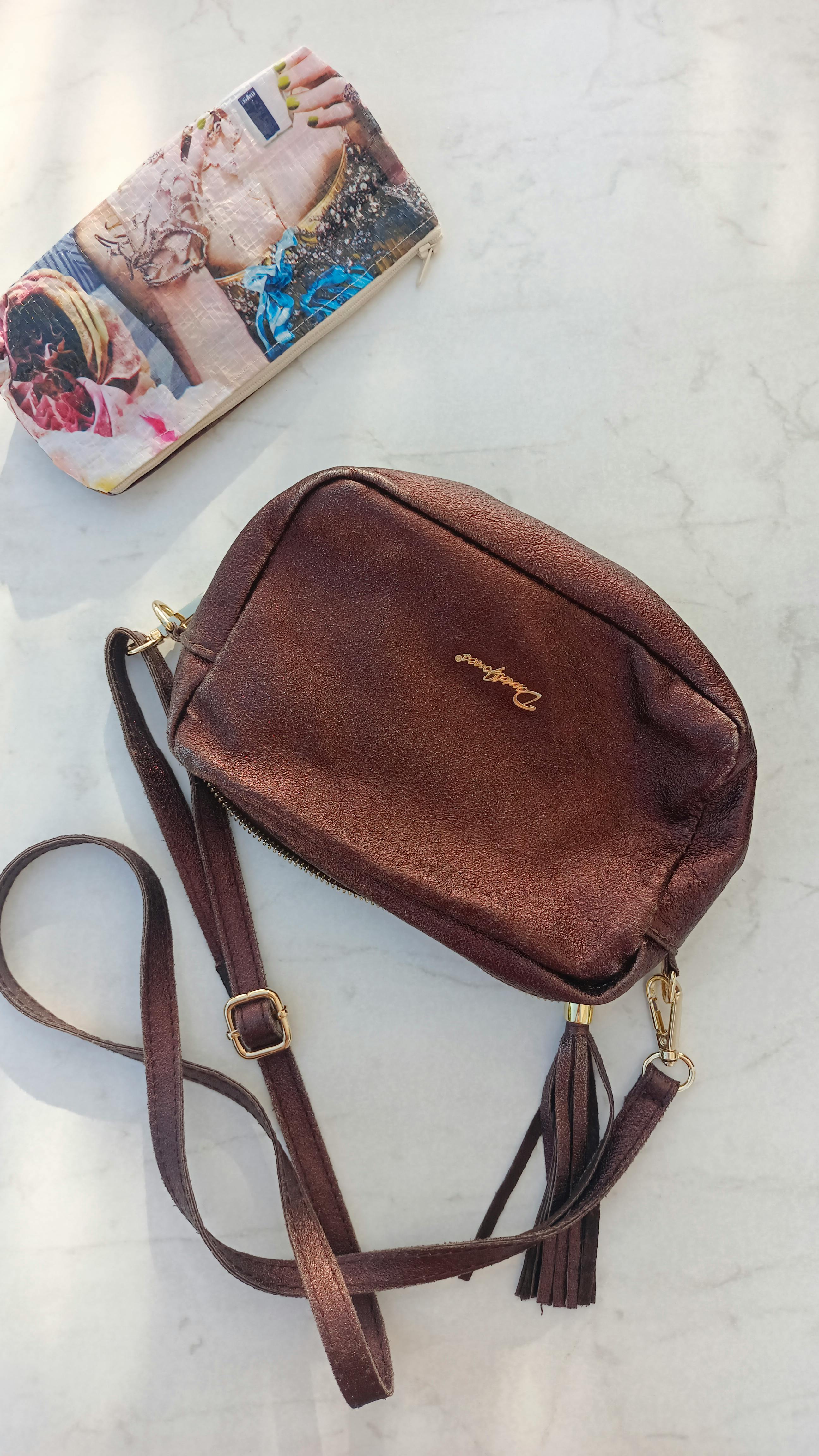
- No exterior plaque, no monogram and no branded fittings anywhere
- Fittings are palladium-plated and matte or brushed, never high-polish gold tone
- Interiors lined in nappa, lambskin, calfskin or cotton herringbone
- A single small stamp low on the outer side, with a crisp stamp inside
Understanding the Margaux Family, and Why It Is Hard to Buy
The majority of buyers think of the Margaux first, and it is equally the most confusing part of the collection to buy from at present. The Soft Margaux 10 is observed at $3,650, built in 100 percent calfskin with a matte grained finish and a cotton herringbone lining, and measures 10 x 7 x 7.5 inches on a 5-inch handle drop. An interior toggle closes it, belted side gussets shape the sides, protective metal feet sit beneath and the shoulder strap detaches. At $4,350, the Soft Margaux 12 holds that construction, measures 12 x 9 x 7.5 inches and includes a zip pocket. Different again is the Margaux Shoulder 12 at $4,900, pairing a lambskin lining and elongated tubular handles with the signature adjustable buckles and narrowed gusseted side panels across 14.75 x 9 x 5 inches. A Margaux 17 exists in leather and canvas at Selfridges, and a Soft Margaux 15 circulates too, though no reliable retail price attaches to either. During 2025 the original was pulled from third-party retailers, and the Soft and Shoulder versions now fill its place on the brand’s own site; that it has been discontinued is widely reported but has never been officially confirmed by the brand.
Totes, Top Handles and Shoulder Bags
The Park family is the volume engine of the line and the most common first purchase. The N/S Park Tote goes Small at $1,550 to $1,620, Medium at $1,650 to $1,950 and Large at $1,990 to $3,250, and the range within a size reflects material and finish rather than capacity. Elsewhere in the family, the Park Tote is $1,450 to $1,620 in Small and Medium, the Park Tote Three $1,750 to $2,400 and the XL Park Tote $2,490. Higher up, a The Row tote bag climbs steeply, with Marlo 14 at $5,300, the Alger Tote at $4,900 and the Marco Bag at $6,900. Among the top handles, suede carries the steepest premium: India 10.00 is $3,850 in leather against $5,370 in suede, while Agnes 15 goes $5,000, $5,800 and $4,300 in leather, suede and a canvas blend. Ida is $3,990, Elise and Agnes 12 both sit at $4,400 and the Iowa Duffle is $5,180, while Idaho keeps the entry position at $1,420. Shoulder styles are equally spread out, running from Lori at $1,350 and the 90’s Shoulder at $1,450 up through Alix at $1,900, Parker at $2,900 and Jean Shoulder at $3,900.
Small Bags, Clutches and the Opening Tier
The most affordable row handbags aren’t pared-back versions of the expensive ones, but smaller problems solved with the same care. The collection’s understated cult piece is the 90’s Bag at $1,090, and alongside it the Half Moon is observed at $1,390, with a leather variant seen at $1,690 at one stockist. There is disagreement between sources over Half Moon dimensions, so the official 8 x 13.5 x 2.5 inches should be your reference and slight disagreement elsewhere is to be expected. The Bourse Clutch at $1,590 shows how much construction goes into the cheaper end, with a calfskin exterior, nappa lining, hinged frame closure, hidden adjustable shoulder strap, 10.2 x 6.5 x 2.3 inches and Made in Italy on the label. Below it sit the Double Travel Wallet at $590, the Cecily Mini Tote and Ray Pouch at $950 and the Squared Compact Clutch at $1,390. Going the other way, the Terrasse To-Go is $1,950, the Dalia Baguette $2,700 and the Peggy Clutch $2,900.
Price Bands at a Glance
Three bands describe the collection well enough to shop by, and they hold across every category. Most buyers meet the brand in the entry band, roughly $590 to $1,500. Roughly $1,550 to $3,500 is the middle band, which covers the Park totes, most shoulder bags and the better clutches. The top band, roughly $3,600 to $6,900, is where the Margaux family, the India and Agnes top handles and the Marlo totes live. Suede consistently carries a premium over calfskin on the same silhouette, a rule that holds in every band. A second rule is even simpler: the number in a bag’s name is its width in inches.
| Bracket | 2026 observed range | Example bags |
|---|---|---|
| Entry | $590 to $1,500 | 90’s Bag $1,090, Half Moon $1,390, Double Travel Wallet $590 |
| Mid range | $1,550 up to $3,500 | Parker $2,900, N/S Park Tote Small $1,550, Bourse Clutch $1,590 |
| Top | $3,600 to $6,900 | Marco Bag $6,900, Soft Margaux 12 $4,350, Margaux Shoulder 12 $4,900 |
Archive Models You Will Now Only Meet on Resale
A large part of the label’s reputation rests on bags no longer sold new, and knowing them changes how you read the secondary market. The Bindle is the best known, a suede shape with raw-cut trims, a knotted detail and an open top, reported to have retailed around $1,190, followed by the Bindle Three with its padded handle and removable inner pouch observed near $1,700. The Sofia is a structured calfskin flap bag with a metal lock closure and a two-compartment interior, observed on resale between roughly $2,200 and $5,668. The Devon is a compact structured top handle in polished saddle leather with a top zip, a hidden shoulder strap and decorative stitching. At approximately 9 x 12.5 x 5.25 inches, the Camden joins grained or saddle leather, twin handles, a detachable strap, a magnetic closure and both patch and zip pockets. Also circulating are the Ascot hobo, the Wander knot crossbody and the nylon Sling 15, none of which carry reliably documented retail figures.
Resale, Authentication and Care
The secondary market is notably strong here, but treat it as observed market behaviour, not investment advice. The Rebag CLAIR 2025 report put The Row at 97 percent brand-level value retention, a first entry into the report’s unicorn tier of 85 percent and above, behind only Telfar, Hermes and Goyard. Individual models did even better: the N/S Park Tote at 146 percent as the strongest performer, the Margaux Tote at 107 percent and the Half Moon shoulder at 106 percent. Not everything appreciates, though, and canvas, nylon, sisal and seasonal-colour pieces routinely discount, with the strength concentrated in black and neutral calfskin in the signature shapes. Shopping The Row for sale second hand involves judging stitching density, hand-painted edges, matte hardware and whether the bag holds its shape empty, since the brand operates no public authenticity coding. Care follows the material rather than any brand-issued protocol: a soft dry cloth on calfskin, dry cloth only on nappa and lambskin, a brush and nothing wet on suede, and spot-cleaning alone for raffia and canvas.